Your flood overlay and your flood history are not the same thing
A property outside the overlay can still flood, and one inside it may never have. What each tells you, and the mitigation that moves the price.
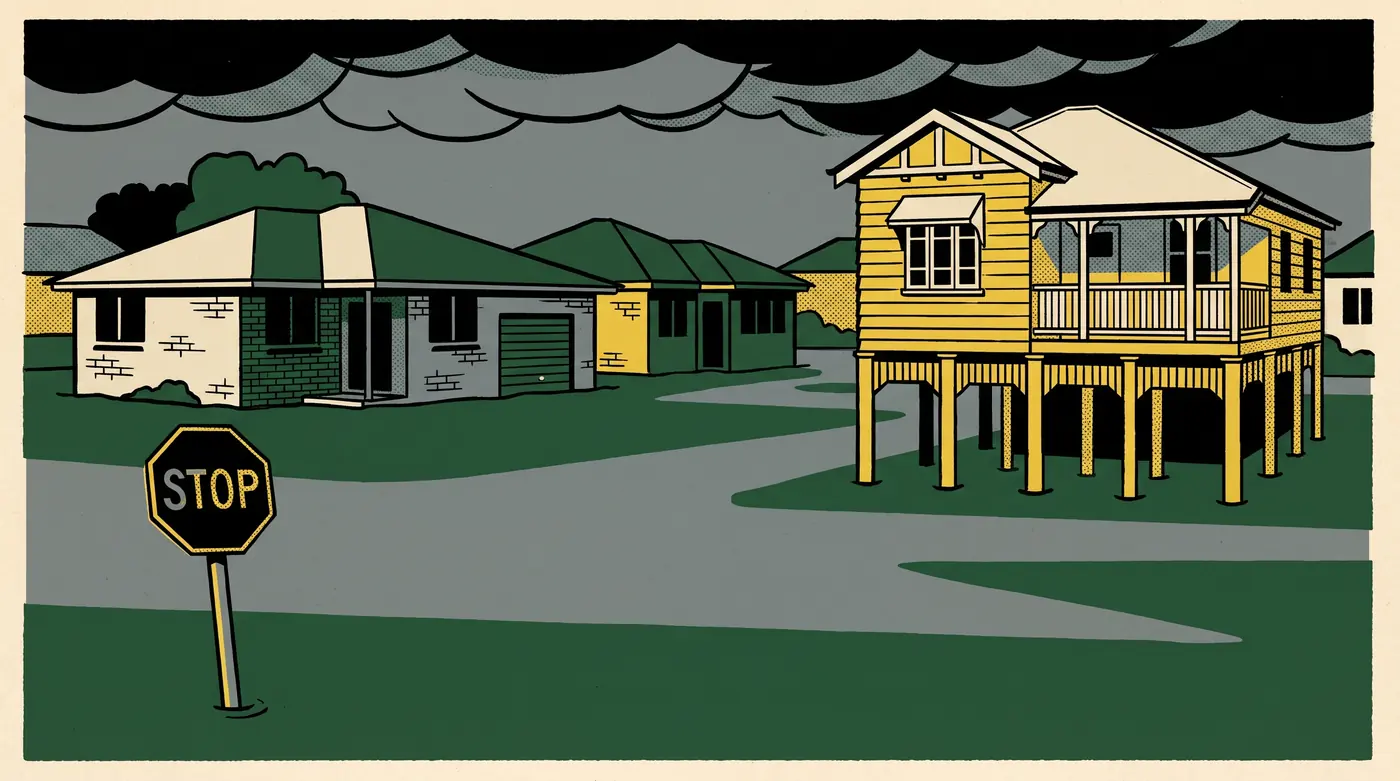
Two sentences get said to us constantly, and both are wrong in the same way. "It has never flooded here, so I do not need flood cover." And "we are in the flood overlay, so nobody will insure us." The overlay and the history are answering different questions, and neither of them is the question an insurer is actually asking.
What a flood overlay is
A flood overlay is a planning instrument. Your council commissioned hydraulic modelling of a design event, usually the one per cent annual exceedance probability flood, the thing people still call a one-in-a-hundred-year flood. The model produced a water surface, and the overlay is the line where that surface meets the ground.
It exists to control what gets built and at what floor level. It was never intended to tell an individual owner what their house will do. Two things follow from that:
- The overlay is binary and your risk is not. A property 50mm inside the line and a property 50mm outside it have almost identical risk, and the overlay puts them in different categories.
- The overlay is as old as the study. Some councils have remodelled since 2022. Some are working from studies done before the catchment upstream was developed.
What flood history is
Flood history is a record of events that happened to reach a place. It is genuinely useful, and it is also badly incomplete. The record for most Australian catchments is a bit over a century long, which is not many samples of a one per cent event. And a house that has never flooded may simply not have been standing during the events that would have reached it.
The 2022 event put water into thousands of properties that had no flood history at all, in catchments where the record looked reassuring. History is evidence. It is not proof.
The number that actually prices it
What an insurer wants is your floor level relative to the modelled flood surface at your specific address, and the depth and velocity of water at that point in a range of events, not just one.
Not "is this property in the overlay" but "in a one per cent event, how deep is the water at this front door, and how fast is it moving".
That is a property-level question and it produces a continuous answer rather than a yes or a no. It is why two houses on the same street can be priced very differently, and why we will tell you which side of that you are on before you buy rather than after you claim.
Everyone means the same thing by the word flood
One genuinely good piece of Australian insurance regulation: flood has a single legislated definition in the Insurance Contracts Regulations, so every insurer in the country means the same thing by it. It is the escape of water from a lake, river, creek, watercourse, reservoir, canal or dam onto normally dry land.
Three practical consequences people miss:
- Storm water and rainwater are not flood. Rain overwhelming your gutters and coming through the ceiling is a storm claim, and it is covered separately.
- Storm surge is neither. Actions of the sea are excluded from home policies in Australia, including under flood. If you are on a coastal frontage, know that.
- Flash flooding is usually flood. If a creek came out of its bank, even for forty minutes, that is flood, regardless of how quickly it went away.
Wattle includes flood as standard on home, contents and landlord policies. There is a 72 hour waiting period from the start of the policy, which exists so a policy cannot be bought once a specific event is already forecast, and it does not restart if you are transferring from another insurer without a gap.
What to do if you are exposed
The mitigation that works for flood is different in kind from the mitigation that works for fire. You are not usually trying to stop the water arriving. You are trying to make the arrival cheap.
- Raise the services. Switchboard, power points, data outlets, hot water system, pool pump, air conditioning condenser. Above the modelled level, not just off the floor. This is the highest-value action on the list by a distance, because it is the thing that turns a four-week dry-out into a four-month rewire.
- Change what the walls are made of. Plasterboard below the flood level replaced with fibre cement or magnesium oxide sheet, and batts replaced with closed-cell insulation. Water goes through and the wall dries out instead of being demolished.
- Non-return valves on the sewer and stormwater connections. Cheap, and it stops the worst version of the clean-up.
- Keep the undercroft clear. If you own a Queenslander on stumps, enclosing underneath into habitable rooms is the single most common way people convert a low-risk house into a high-risk one.
Raised services and resilient linings together commonly reduce an at-risk home premium by 10 to 18 per cent on our book, because they reduce the size of the claim rather than its likelihood, and the size of the claim is what the price is made of.
Read the rest of the flood section of the resilience programme, or ask us for a report on your address and stop guessing which side of the line you are on.
General advice only. This article is general information prepared without taking into account your objectives, financial situation or needs. Consider the PDS and TMD before deciding on any product, and get advice about your own property from a qualified professional. Wattle Insurance is a fictional brand and this is a demonstration site.